
Home / Case Studies / Corrosion Resistance and Explosion…
Chemical Manufacturing
Corrosion Resistance and Explosion Protection in One Collector
48,000 ACFM in 316L stainless for a specialty chemical plant handling powders that were corrosive and combustible at the same time.
The client
Two Problems That Usually Have Different Answers
A specialty chemical manufacturer operating a Midwest production facility producing organic and inorganic intermediates for agricultural, pharmaceutical, and industrial markets. The plant handles powdered compounds that are variously corrosive, hygroscopic, and combustible in suspension.
Reaction, drying, milling, screening, and packaging all generate fine chemical dust requiring capture — for worker health, for cross-contamination control between products, and for environmental and safety compliance.
The existing carbon steel baghouse had served for many years but was failing on both fronts that mattered most: it was corroding, and it was not protected against the explosion risk the materials presented.
At a glance
| Industry | Specialty chemical manufacture |
|---|---|
| Airflow | 48,000 ACFM |
| Challenge | Corrosive and combustible simultaneously |
| Material | 316L stainless steel |
| Solution | Corrosion-resistant collector, layered protection |
The challenge
What They Were Facing
Corrosion
Many of the dusts handled are corrosive, particularly with moisture present. Carbon steel construction had corroded significantly over time, causing structural weakening, air leaks, and rising failure risk — while creating harbourage points for chemical residue.
Capture inconsistency
As volumes grew and formulations changed, the system could no longer capture consistently at all required points, producing visible accumulation in some areas and occasional stack emission excursions.
Regulatory and insurance scrutiny
Corrosive materials plus combustible dust put the facility under heightened attention from both regulators and the insurer.
Combustible dust hazards
Several processed materials are combustible in suspension. A Dust Hazard Analysis identified gaps in deflagration venting, explosion isolation, and spark detection.
Maintenance and downtime
Corrosion damage drove frequent repairs. Bag life was shortened by chemical attack and moisture. Maintenance sometimes required extended shutdowns that hit production schedules.
Our approach
316L, and Four Layers of Protection
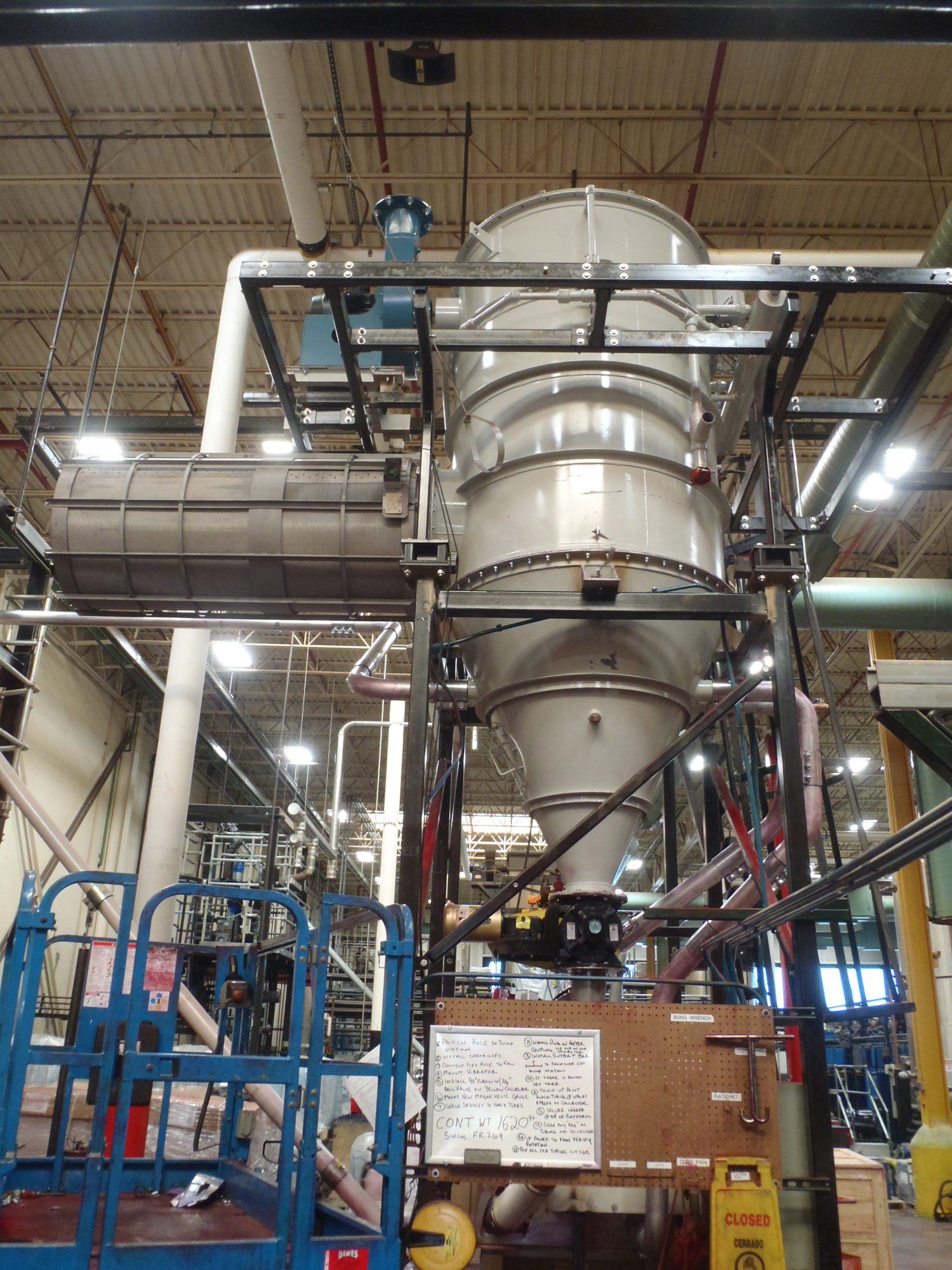
Material selection. Given the corrosive dusts and moisture exposure, we specified 316L stainless steel as the primary construction material, with higher alloys and protective coatings evaluated for components in the most extreme conditions.
Explosion protection strategy. Working from the client’s DHA explosibility data, we designed four layers: deflagration venting sized to NFPA 68 and directed to safe outdoor locations; chemical explosion isolation valves on main duct runs; spark detection and suppression upstream of the baghouse; and comprehensive grounding and bonding to control static.
Design features. Smooth internal surfaces with minimal ledges to reduce accumulation and ease cleaning; filter media selected for chemical compatibility and dust release; optimised gas distribution protecting bags from direct impingement; an easy-clean rotary airlock discharge; and a walk-in clean air plenum with full access platforms.
Specifications
As Built
| Airflow capacity | 48,000 ACFM |
|---|---|
| Construction material | 316L stainless steel |
| Filter media | Chemically resistant polyester or PPS with membrane |
| Design temperature | Up to 300°F, process-stream dependent |
| Explosion protection | Deflagration venting, isolation valves, spark detection and suppression |
| Cleaning system | Pulse jet with corrosion-resistant components |
| Access | Walk-in clean air plenum with full platforms |
| Discharge | Stainless rotary airlock, easy-clean features |
Planned and executed to minimise production impact, with major components delivered in sections to accommodate building constraints. Our field service team worked with client maintenance and engineering through installation and commissioning, with particular attention to grounding continuity, alignment of explosion protection devices, and integration with plant control and safety systems.
Results
What Changed After Commissioning
Equipment life extended by half again
316L stainless is expected to deliver 50–60% more service life than the carbon steel system it replaced. On an asset of this size that is the single largest number in the business case — corrosion had been driving both the repair cycle and the eventual replacement date, and both have moved out substantially.
Capture efficiency up 14%
Dust capture improved by 14% across the connected process areas, with operators reporting reduced visible accumulation. In a plant running multiple product formulations, that is a cross-contamination control as much as an air quality one.
Bag life up 50%
Filter bag life has gone from roughly twelve months to eighteen. Chemical attack and moisture had been the limiting factors; media selected for chemical compatibility and dust release, combined with gas distribution that keeps abrasive impingement off the bags, addressed both.
Combustible dust safety
Integrated protection has brought the system into alignment with the DHA recommendations and current NFPA standards, addressing the concerns raised by both the regulator and the insurer.
Related
More From CPE Filter Systems
Product
Combustible Dust Collection
The layered protection approach applied here.
Product
Baghouse Dust Collectors
Stainless and specialty alloy configurations.
Service
Rebuilds & Re-Cores
Where corrosion hasn’t gone too far, re-coring is often the better answer.
Facing Something Similar?
Every one of these started with a site assessment — gas flow measurement, dust sampling, and a look at your operating data. Tell us what you’re dealing with.