
Home / Capabilities / Explosion Protection
Combustible Dust Explosion Protection
DHA support, NFPA gap assessment, and retrofit evaluation — the work, not the hardware.
The capability
From Dust Hazard Analysis to Installed Protection
This page is about the work, not the equipment. If you want the collectors themselves, see combustible dust collection systems.
Most plants come to us at one of three points: a Dust Hazard Analysis has identified gaps and nobody is sure what they mean in practice; an insurer or corporate risk team has asked for upgrades; or an incident somewhere else in the industry has prompted a review.
In all three cases the question is the same — what does compliance actually require here, on this equipment, with this material? We answer that with explosibility data, process geometry, and the standards, rather than with a product catalogue.
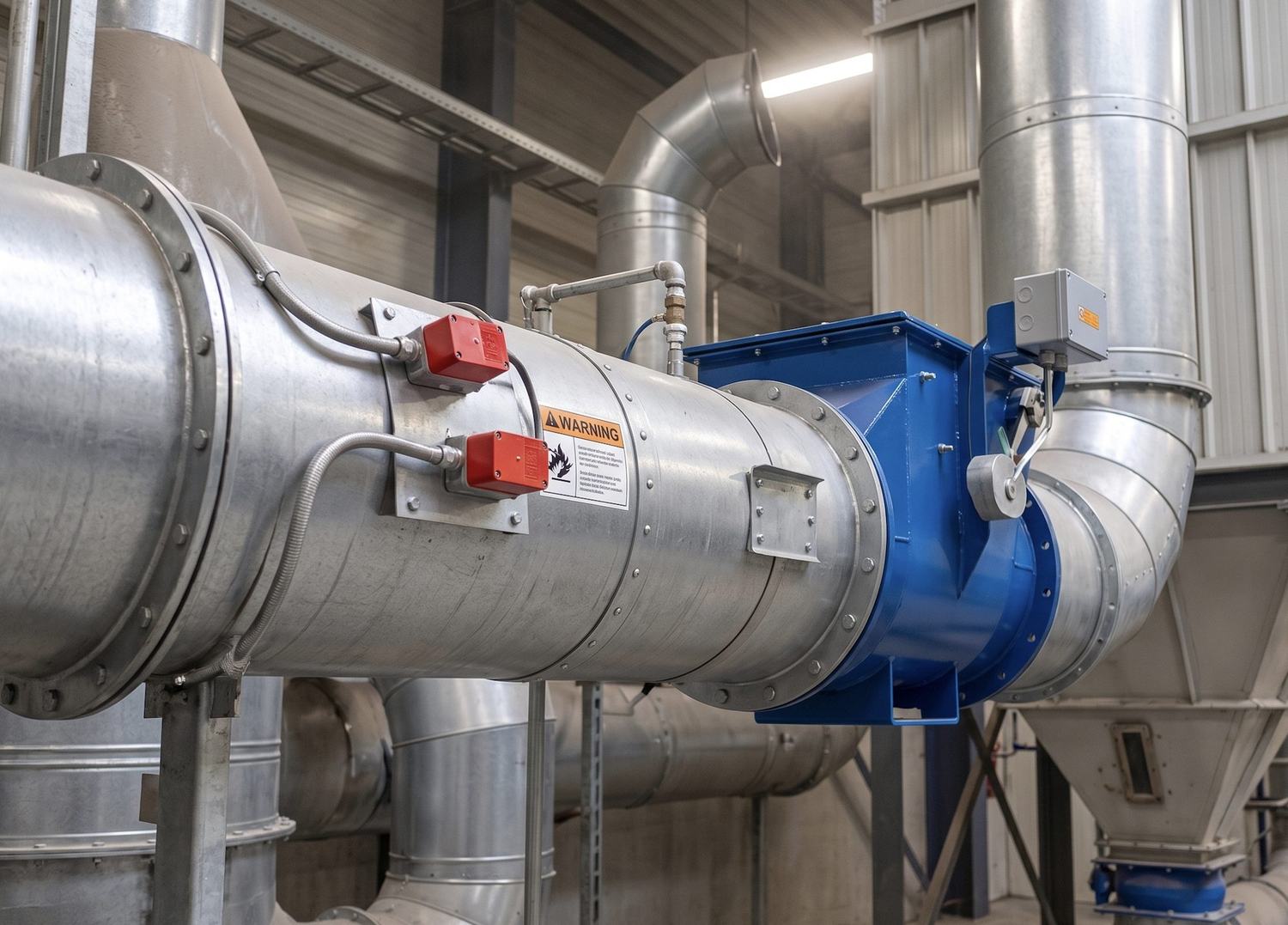
Our support
Where We Come In
STAGE 01
DHA support
Guidance on sampling and testing, interpretation of Kst, Pmax, and MIE results, and translation of findings into equipment requirements.
STAGE 02
Gap assessment
Review of existing collectors, ductwork, and discharge against NFPA 652/660, 68, and 69 — identifying what is compliant, what is not, and what is arguable.
STAGE 03
Retrofit evaluation
An honest answer on whether protection can be added to your existing equipment, or whether housing rating, siting, or duct geometry makes replacement the better route.
STAGE 04
Design and documentation
Vent area calculations, isolation placement, detection layout, and grounding design — documented in the form your regulator and insurer will ask for.
Common findings
What Gap Assessments Usually Turn Up
Missing isolation
A vented collector with no duct isolation can still propagate a flame front back into upstream process equipment. This is the most frequent single gap we find.
Grounding discontinuity
Bonding that was continuous at commissioning and was broken by a later duct modification, a flexible connector, or a replaced airlock.
Vent area sized by assumption
Relief panels selected from a catalogue rather than calculated from the actual measured Kst of the material being handled.
Indoor collectors with outdoor venting assumed
A vent path that terminates inside the building, or discharges toward an occupied area or an access route.
Housekeeping as the unaddressed hazard
Equipment protection designed properly while accumulated dust on structures remains the larger secondary explosion risk.
No documented design basis
Protection that may well be adequate, with no calculation package to demonstrate it when the insurer asks.
Proof in service
Where this has been done
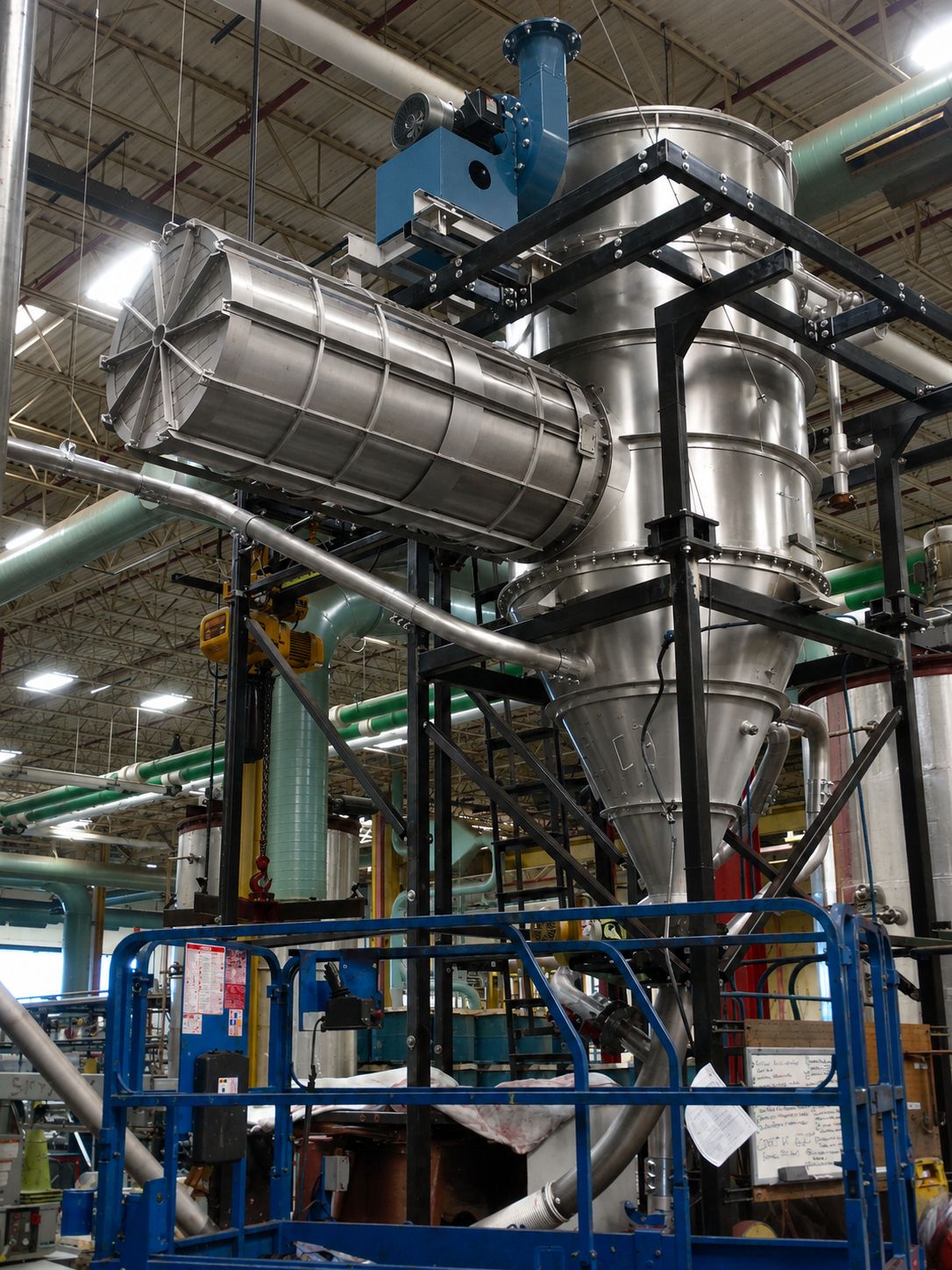
Chemical Manufacturing
316L Collector for Corrosive, Combustible Chemical Dust
Four protection layers sized from the client’s own DHA data. 48,000 ACFM in 316L.
Talk to an Engineer
Tell us the process conditions and the constraints. We’ll tell you what’s achievable and what it takes.