
Home / Industries / Chemical Manufacturing
Industry
Dust Collection for Chemical Manufacturing
Powders that are corrosive and combustible at once. Two hazards whose remedies pull in opposite directions, and the 316L specification that resolves them.
The Dust
Specialty chemical powders are frequently corrosive and combustible at the same time. Many are hygroscopic, picking up moisture and changing behaviour between the process and the collector. Some are valuable enough that recovery matters as much as capture.
What Makes It Difficult
Two hazards that pull in opposite directions. Corrosion resistance points toward stainless and smooth internal surfaces. Explosion protection points toward venting, isolation and suppression hardware — every penetration of which is a potential corrosion path and a potential ledge for accumulation. Resolving that tension is the design problem.
Cross-contamination. Where a plant runs multiple products through shared equipment, residue from one campaign in the next is a quality failure, not a housekeeping issue.
Mixed contaminant streams. Fine particulate, corrosive vapour and sticky residue in one stream. No single collector handles all three, and no catalogue unit is designed to try.
What We Specify
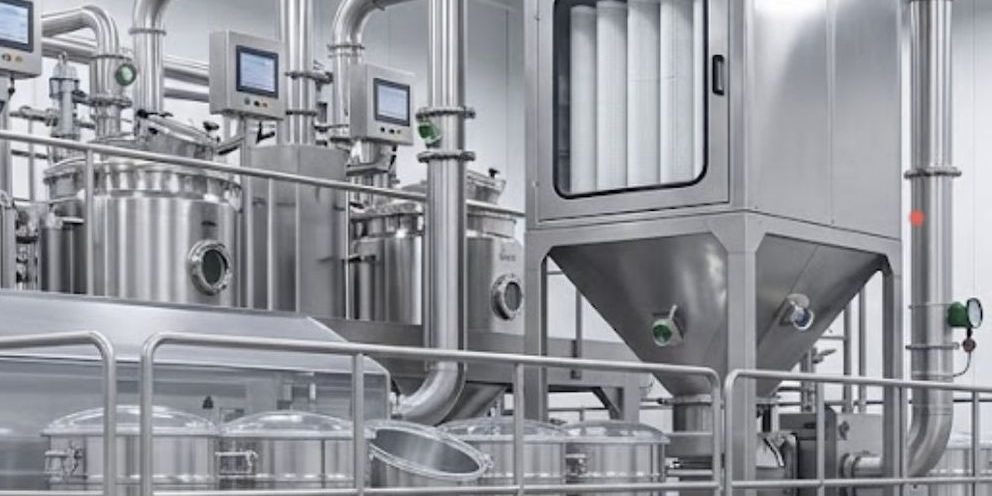
316L stainless as the baseline, with higher alloys and protective coatings evaluated for components in the most extreme positions. Smooth internal surfaces with minimal ledges — accumulation is both a cleaning problem and an explosion fuel source.
Explosion protection in four layers, each sized from the client’s own DHA explosibility data rather than a general assumption about the material: deflagration venting to NFPA 68 directed to a safe location, chemical isolation valves on main duct runs, spark detection and suppression upstream, and comprehensive grounding and bonding.
Media selected for chemical compatibility and for dust release, which are different properties. A membrane that resists attack but holds product is a cleaning problem you will have every week.
Where the stream is genuinely mixed, staged filtration: particulate capture followed by gas-phase or activated carbon modules.
Powders both corrosive and combustible. Bag life rose from 12 to 18 months, capture efficiency by 14 points, and equipment life downstream extended 50–60%. All four protection layers sized from client DHA data.
Read the full case study →Regulatory Context
NFPA 652 requires a DHA; NFPA 654 governs the technical requirements. Where the plant exports or operates internationally, ATEX and FM Global requirements apply in addition — and they are not identical. See our article on designing for international compliance.
Related equipment
What we typically specify here
Tell Us What You Process
Send us the material, the process and the constraint. We will tell you what we would specify.