70 terms used in dust collection specification, written plainly. Where a term is commonly misunderstood, the entry says what the misunderstanding is.
A
ACFM
Actual cubic feet per minute — gas volume at the actual temperature, pressure and moisture of the process. Collectors are sized in ACFM, not SCFM, and confusing the two is a common sizing error.
Air-to-cloth ratio
Airflow in CFM divided by filter area in square feet, expressed as e.g. 3.8:1. The single most consequential number in a fabric collector specification. Too high and bags abrade and blind; too low and you have paid for housing you do not need.
Anti-static grid
Conductive fibre woven into media to dissipate static. Not optional where the dust is combustible.
ATEX
EU directive governing equipment in potentially explosive atmospheres. Applies where equipment is sold into or operated within the EU.
B
Baffle plate
A plate at the inlet that breaks the incoming stream and drops the coarse fraction before it reaches the bags. Its absence shows up as wear on the lower outer surface of the nearest bags.
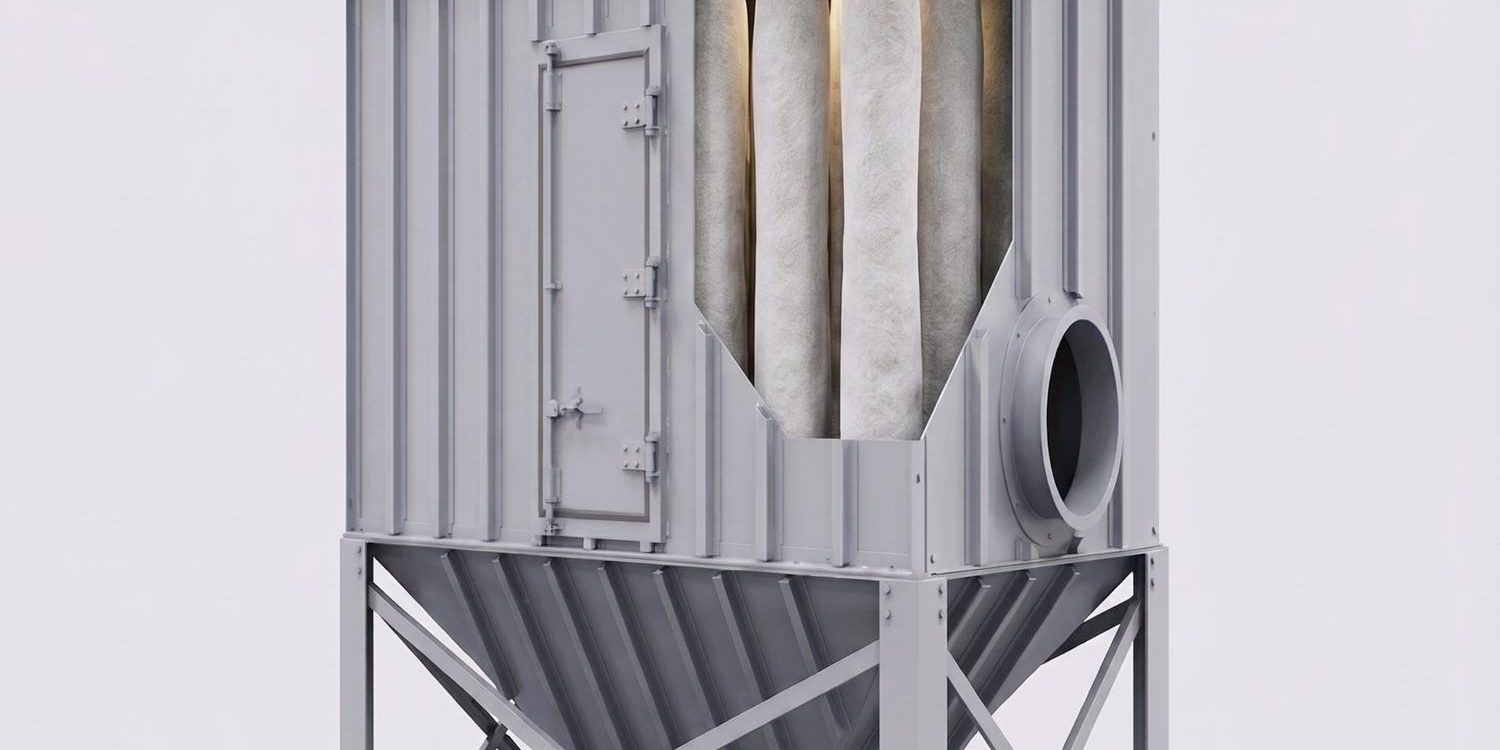
Baghouse
A fabric filter collector using tubular bags. The most widely specified collector for heavy loading, high temperature and abrasive dust.
Bin vent
A compact filter mounted on top of a silo or hopper, venting displaced air during filling and returning captured material to the vessel.
Blinding
Dust penetrating the media so that cleaning no longer recovers pressure. Usually caused by a ratio that is too high, or media wrong for a sticky or hygroscopic dust.
Blow pipe
The perforated tube above each row of bags that delivers the pulse. Misalignment after a bag change is a common cause of one dirty row.
Bridging
Material arching across a hopper so it will not discharge. A valley angle or airlock problem, not a dust problem.
C
Cake
The layer of dust that builds on the media surface and does much of the filtering in a depth filter. Losing it entirely by over-cleaning raises emissions.
Compressed air
Pulse cleaning demand, in SCFM. Frequently the constraint nobody checked — a collector specified without confirming plant air capacity will underclean from day one.
Cage
The wire frame supporting a filter bag against collapse. Cage quality decides bag life more than most people expect, particularly with fibreglass.
Can velocity
Upward gas velocity in the space between bags. Too high and dust knocked off one bag is re-entrained onto the next, so cleaning never fully works.
Cartridge collector
A collector using pleated cartridge elements rather than bags — more filter area in a smaller housing, best on fine dry dust.
Cyclone
A mechanical separator using centrifugal force. No media, no cleaning cycle, effective above about 10 microns. Often specified ahead of a fabric collector.
Combustible dust
Any finely divided solid that presents a fire or explosion hazard when suspended in air. Includes flour, sugar, wood, most metals, and many chemicals.
D
Damper
A movable plate controlling airflow in a duct. Balancing dampers set branch flows; isolation dampers take a compartment offline.
Duct velocity
Transport velocity in the ductwork, in feet per minute. Must be high enough to keep the heaviest fraction in suspension; settled dust in a duct is both a blockage and a fuel load.
Deflagration
A combustion wave travelling below the speed of sound. What dust explosion protection is designed to vent or suppress.
Dew point
The temperature at which moisture in the gas stream condenses. Operating below it blinds media permanently.
DHA
Dust Hazard Analysis. Required by NFPA 652. Establishes explosibility characteristics and the protection they demand.
Differential pressure
Pressure drop across the media, the primary health indicator of a collector. A stable figure is good; a climbing one is a problem; a falling one is usually a failure.
Dust collector
Equipment that separates particulate from a gas stream. Fabric, cartridge, cyclone, wet or electrostatic.
E
Explosion isolation
Preventing a deflagration in the collector from propagating back through ducting into the building. Chemical or mechanical.
Excursion temperature
The peak temperature the system will see in an upset, as distinct from continuous. Media must be specified against this figure, not the running one.
Explosion vent
A panel designed to rupture at a set pressure and direct a deflagration to a safe location. Sized to NFPA 68.
F
Fan curve
The relationship between airflow and static pressure for a given fan. Where the system curve crosses it determines actual airflow, which is rarely the design figure.
Fabric filter
See Baghouse. Any collector using flexible media to separate particulate.
Filter area
Total media surface, in square feet. Divided into airflow to give air-to-cloth ratio.
Filter receiver
A collector at the terminus of a pneumatic conveying line, separating product from conveying air and returning it to process.
Fugitive emissions
Dust escaping from points other than the stack — transfer points, loading, discharge. Often the source of most complaints, and not measured by a stack test.
Flameless venting
A vent fitted with a mesh flame arrester, allowing a deflagration to vent indoors where an outdoor path is unavailable.
H
HEPA
High Efficiency Particulate Air. 99.97% capture at 0.3 micron. A final stage, not a primary collector.
Hydrolysis
Chemical breakdown of media in hot moist conditions. Destroys polyester and aramid; a bag can lose strength while looking intact.
Hopper
The tapered lower section where captured dust collects before discharge. Not storage — material should leave as fast as it arrives.
Hygroscopic
Absorbing moisture from the air. Hygroscopic dust cakes in the hopper and blinds media unless moisture is controlled.
I
Induced air
Air dragged along by falling material at a transfer point. Controlling it at the chute reduces the extraction volume required, often substantially.
Inlet plenum
The chamber distributing incoming gas across the bags. Poor distribution loads one section and starves another.
K
K-St
A measure of how rapidly a dust deflagration develops pressure, in bar-metres per second. Determines vent area. Established by DHA testing.
M
Membrane
A microporous PTFE film laminated to media so dust sits on the surface rather than entering. Changes a depth filter into a surface filter.
Micron
One millionth of a metre. Respirable dust is generally below 10 microns; cyclones become ineffective around that threshold.
N
Nomex
DuPont trade name for meta-aramid media. See Aramid.
NFPA 61
The standard for agricultural and food processing facilities. Applies instead of NFPA 654 in those industries.
NFPA 68
Standard on explosion protection by deflagration venting. Governs vent sizing and where the vent may discharge.
NFPA 484
Standard for combustible metals. More restrictive than NFPA 652 and applicable to aluminium, magnesium and titanium dust.
NFPA 69
Standard on explosion prevention systems — isolation, suppression, and oxidant reduction.
NFPA 652
The fundamentals standard. Establishes the DHA requirement.
NFPA 654
Technical requirements for combustible particulate solids in general industry.
O
Opacity
A measure of how much light a plume obstructs, used in continuous emissions monitoring at many permitted sites.
P
P-84
Polyimide media, rated to 500°F. Trilobal fibre gives high efficiency on fine particulate without a membrane.
P-max
Maximum explosion pressure a dust can generate in a closed vessel. With K-St, determines protection design.
Pleated bag
A bag with folded media, offering 50–100% more area in the same tube sheet. A retrofit route where ratio is too high and space is unavailable.
PPS
Polyphenylene sulphide media, rated to 375°F. Specified for acid resistance rather than temperature.
Pulse jet
Cleaning by a short burst of compressed air that shocks the bag and sheds the cake. The dominant cleaning method in modern collectors.
R
Re-entrainment
Dust knocked off one bag being carried onto another rather than falling to the hopper. Caused by excessive can velocity.
Reverse air
Cleaning by reversing gas flow through the bags. Gentler than pulse jet, used in large high-temperature installations.
Rotary airlock
A rotating vaned valve discharging dust while maintaining the pressure seal. Undersizing it is a common cause of hopper accumulation.
S
Solenoid valve
The electrically operated valve that triggers each diaphragm valve. A failed solenoid leaves one row uncleaned.
Suppression
Injecting a chemical agent to extinguish a deflagration before it develops full pressure. Specified where venting is not possible.
SCFM
Standard cubic feet per minute — volume at defined reference conditions. Convert to ACFM before sizing anything.
Shaker collector
A collector cleaned by mechanically shaking the bags, off-line. Suits intermittent duty and needs no compressed air.
Spark detection
Optical or thermal detection of ignition sources upstream of a collector, usually paired with suppression.
Static pressure
Resistance to airflow in a system, in inches water gauge. Governs fan selection.
Singed finish
Media surface treated so protruding fibres are melted flat, improving dust release. Worth specifying on almost any felt.
T
Transfer point
Any place material changes direction or drops. Generates dust through induced air, and usually the largest source of fugitive emissions.
Tube sheet
The plate separating dirty and clean sides, into which bags are mounted. A leak here bypasses filtration entirely.
V
Venturi
A restriction above each bag that amplifies the pulse. Not present on all designs.
W
Wet collector
A scrubber using liquid to capture dust. The correct answer for some combustible metal dusts where a dry collector would be a hazard.