
Home / Case Studies / Multiple Ageing Collectors Replace…
Metal Recycling
Multiple Ageing Collectors Replaced by One Central System
155,000 ACFM of centralised collection for a metal recycling facility — consolidating a decentralised patchwork into a single engineered system with full explosion protection.
The client
A Patchwork That Stopped Working as Volumes Grew
A Midwest metal recycling and recovery facility processing ferrous and non-ferrous scrap containing zinc, lead, copper, and other metals. The plant receives, sorts, shreds, and melts metal-bearing material to recover metals for reuse.
Shredding, shearing, and melting generate substantial fine metallic dust and fume — abrasive, and in some cases presenting combustion or explosion risk depending on the material and the presence of organic contaminants.
Collection was handled by multiple smaller, older collectors serving different plant areas — an arrangement that had stopped working as volumes grew.
At a glance
| Industry | Metal recycling and recovery |
|---|---|
| Airflow | 155,000 ACFM |
| Challenge | Decentralised, ageing, under-protected |
| Approach | Consolidation onto one system |
| Solution | Centralised pulse jet baghouse |
The challenge
What They Were Facing
High dust loads and abrasive wear
Shredding and material handling produced dust volumes that regularly overwhelmed the existing collectors, driving visible emissions and rapid wear on bags and internal components.
Fire and explosion risk
Fine metallic dust combined with organic contaminants present in scrap creates real fire and explosion hazards. The existing systems had limited or outdated protection, and a Dust Hazard Analysis called for improvement.
Operating cost
Maintaining multiple collectors consumed significant labour. Abrasive dust shortened media life, compressed air consumption was high, and dust-collection downtime was starting to affect throughput.
Inconsistent capture across the plant
With collection split across multiple systems, some areas were served poorly — creating housekeeping problems, accumulation on equipment and structures, and worker exposure concerns.
Regulatory pressure
Rising production brought greater scrutiny of stack emissions and fugitive dust, and the ageing collectors made consistent permit compliance progressively harder.
Our approach
One System Instead of Several — an Architectural Decision
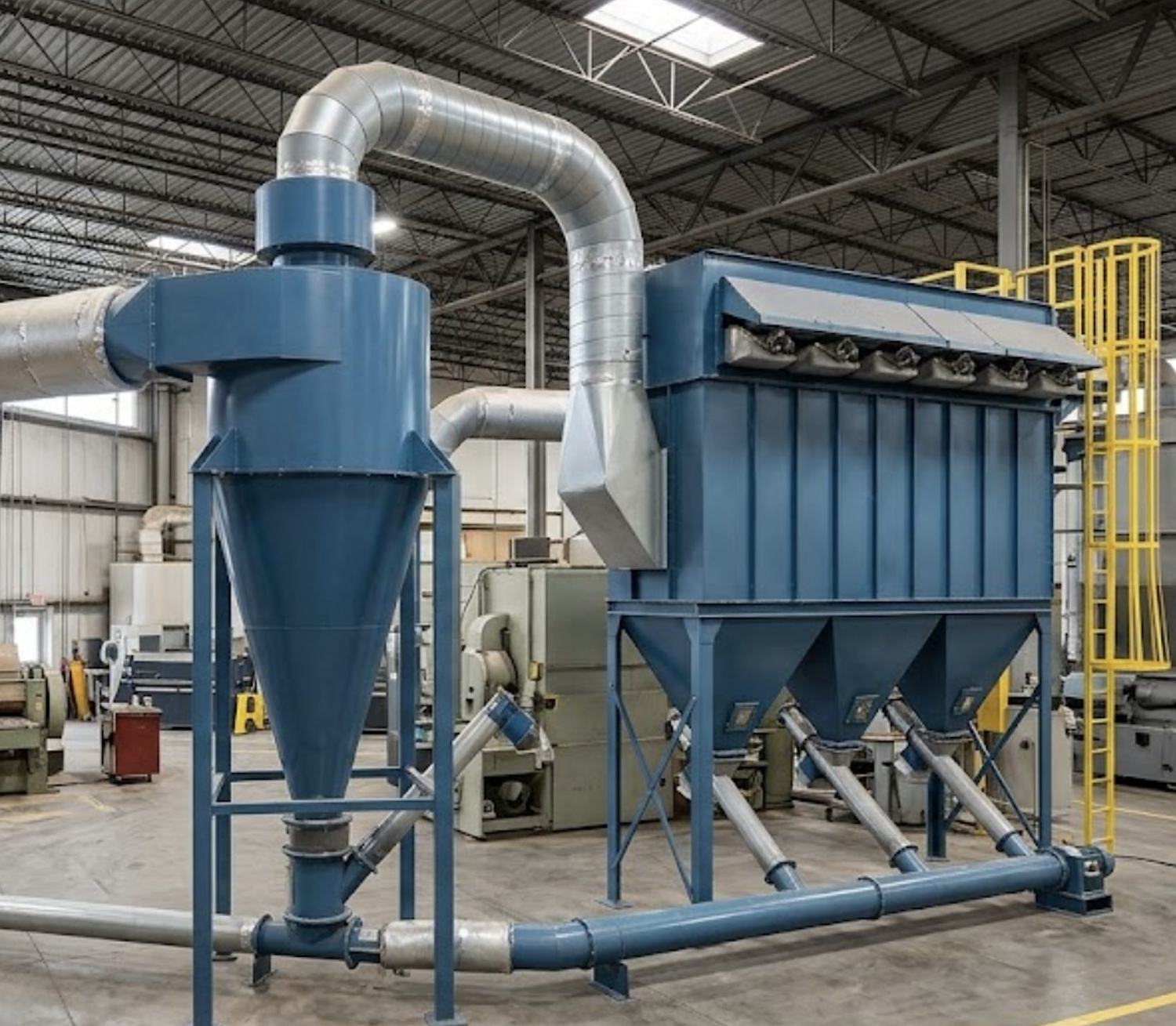
The central decision was architectural. Rather than replacing several small collectors with several new small collectors, we recommended consolidating onto a single high-capacity pulse jet baghouse.
That approach delivers better overall capture, more consistent emissions performance, dramatically simpler maintenance, and — critically — makes it economic to specify modern safety systems properly, once, rather than several times over.
Design features: heavy-duty construction sized for abrasive metallic dust; media selected for dust release and abrasion resistance; optimised inlet and gas distribution to protect bags; deflagration venting, explosion isolation valves, and spark detection with suppression; structural design supporting the collector and an extensive duct network; a walk-in clean air plenum; and a discharge system built for high dust volume.
Sized at approximately 155,000 ACFM with margin for growth, connected to multiple generation points across the facility through a heavy-duty ductwork network, and specified with a conservative air-to-cloth ratio to protect filter life under high loading.
Specifications
As Built
| Airflow capacity | 155,000 ACFM |
|---|---|
| Construction material | Heavy-gauge carbon steel, abrasion-resistant options |
| Filter media | High-performance polyester or aramid, special treatment |
| Design temperature | Up to 350°F |
| Explosion protection | Deflagration venting, isolation valves, spark detection and suppression |
| Cleaning system | High-efficiency pulse jet |
| Access | Full walk-in clean air plenum with platforms |
| Discharge | Heavy-duty rotary airlocks and conveying equipment |
Phased so the facility could maintain production throughout. The central collector was installed on a prepared foundation with extensive ductwork modification coordinated against the production schedule. Our field service team worked alongside plant maintenance and engineering through installation and commissioning, with particular attention to correct installation of explosion protection devices and control system integration.
Results
What Changed After Commissioning
Fugitive emissions cut by three quarters
Centralisation dramatically improved capture in the areas the old patchwork served poorly, reducing visible fugitive emissions by 75%. Operators report cleaner working conditions and markedly less dust accumulation on equipment and structures — the change most visible from the plant floor.
Maintenance concentrated rather than scattered
Maintenance labour has fallen because attention now goes to one well-designed collector instead of several ageing units, and compressed air consumption has been optimised across the single system.
Bag life up roughly half
Filter life has improved by close to 50% against the previous decentralised collectors. A single correctly-sized system with a conservative air-to-cloth ratio does what several undersized ones could not, particularly under the abrasive loading that shredding produces.
Safety
Integrated explosion protection and spark detection have meaningfully improved the risk profile against current combustible dust expectations — protection specified once, properly, rather than several times inadequately.
Related
More From CPE Filter Systems
Product
Baghouse Dust Collectors
The collector type supplied on this project.
Product
Combustible Dust Collection
Protection for metallic dust with organic contamination.
Capability
Turn-Key Solutions
Engineering through commissioning on a live production site.
Facing Something Similar?
Every one of these started with a site assessment — gas flow measurement, dust sampling, and a look at your operating data. Tell us what you’re dealing with.