
Home / Case Studies / A Stainless Baghouse That Satisfie…
Food Processing
A Stainless Baghouse That Satisfies Both the Sanitation Auditor and the DHA
65,000 ACFM of 304 stainless collection for a baking ingredients plant — full explosion protection, wash-down capable, and designed for tool-free bag changes.
The client
Three Teams, Three Different Definitions of Success
A leading manufacturer of baking ingredients and mixes, running a large Midwest production facility that processes high volumes of flour, sugar, starch, and other dry ingredients daily for commercial bakeries across North America.
Receiving, storage, conveying, blending, and packaging all generate fine airborne dust — and flour, sugar, and starch are all combustible in suspension. Some of the installed collection equipment was more than fifteen years old and no longer met the plant’s production demands, sanitation standards, or current safety expectations.
What made this project unusual was that engineering, safety, and sanitation each had legitimate and partly competing requirements. The design had to serve all three.
At a glance
| Industry | Baking ingredients manufacture |
|---|---|
| Airflow | 65,000 ACFM |
| Challenge | Combustible dust plus sanitation |
| Materials | Flour, sugar, starch |
| Solution | 304 stainless pulse jet baghouse |
The challenge
What They Were Facing
Combustible dust, inadequately protected
The existing collectors lacked proper deflagration venting, explosion isolation, and spark detection. A Dust Hazard Analysis identified several gaps against NFPA 660 and OSHA expectations.
Capture and cross-contamination
Visible dust accumulation on equipment and floors in several production areas created a housekeeping burden and raised legitimate questions about product cross-contamination and employee exposure.
Insurance and corporate risk
Following the DHA, both the insurer and the corporate risk team required upgrades aligning the collection systems with current practice.
Cleanability
Carbon steel collectors and ductwork in a food plant are difficult to clean thoroughly. The plant had concerns about harbourage points for pests and microbial growth, and about wash-down procedures the equipment wasn’t designed to survive.
Moisture and bag life
Around sugar handling in particular, moisture-related issues were driving frequent bag replacement and rising maintenance cost, with unplanned downtime during peak production becoming unacceptable.
Our approach
One Design, Three Sets of Requirements
CPE Filter Systems worked directly with the client’s engineering, safety, and sanitation teams to develop a design that served all three.
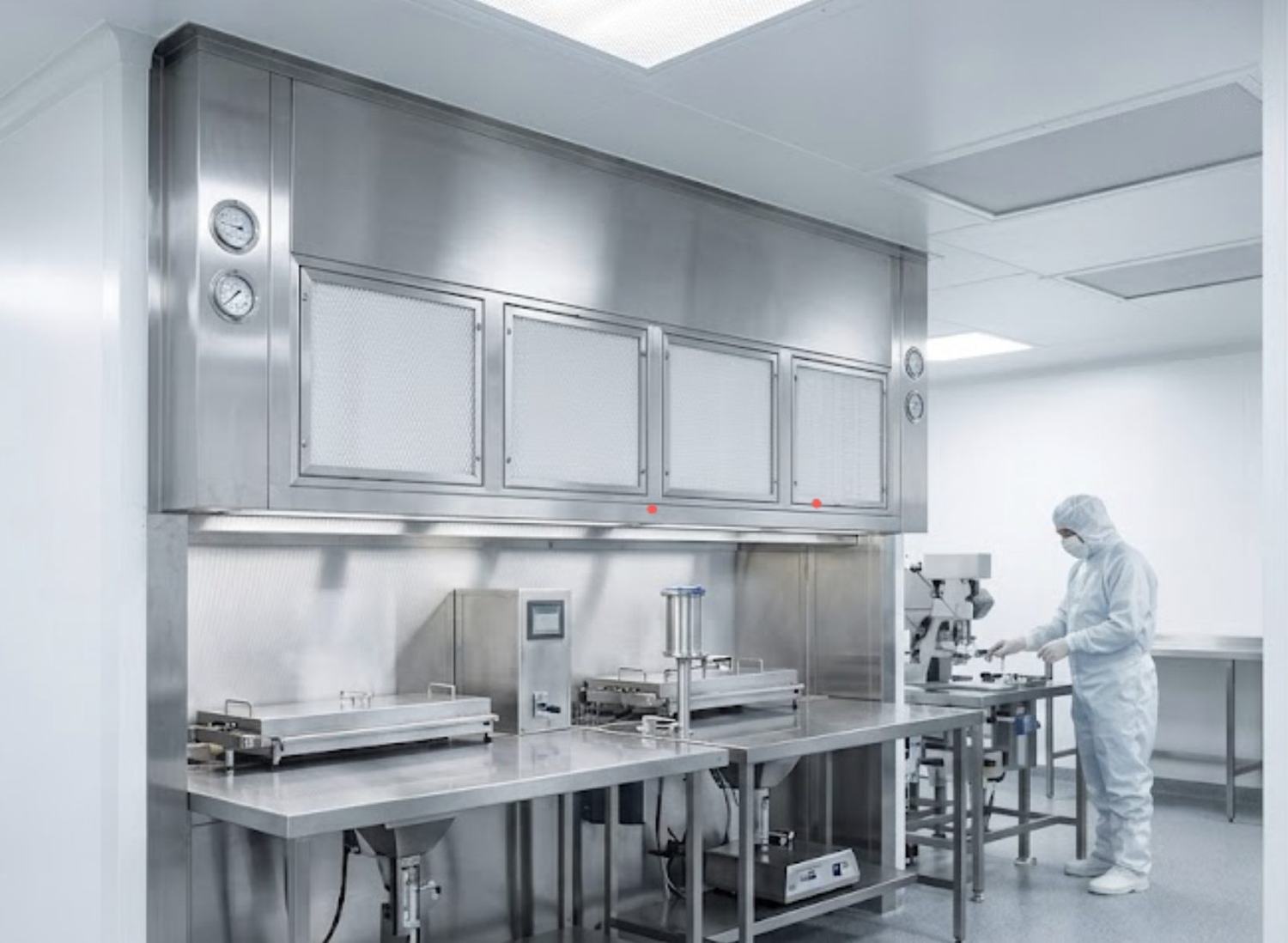
Construction. A custom pulse jet baghouse built primarily from 304 stainless steel, resisting corrosion from sugar dust and supporting rigorous sanitation. Internal surfaces were designed to minimise crevices — smooth internal welds, polished surfaces where appropriate, sloped hopper bottoms, and discharge geometry that prevents material buildup.
Explosion protection. Working from Kst and Pmax values typical of flour and starch: deflagration venting sized and directed to safe outdoor locations, explosion isolation valves on key duct runs, spark detection and suppression upstream of the collector, and grounding and bonding throughout to control static.
Maintenance design. Stainless filter cages and snap-band bags for tool-free changes, a walk-in clean air plenum with accessible doors, and a design supporting both dry cleaning and controlled wet wash-down.
Specifications
As Built
| Airflow capacity | 65,000 ACFM |
|---|---|
| Construction material | 304 stainless steel, food-grade |
| Filter media | Food-grade polyester with PTFE membrane |
| Cleaning system | Pulse jet, optimised low-pressure pulsing |
| Explosion protection | Deflagration venting, isolation valves, spark detection |
| Access | Walk-in clean air plenum, sanitary design |
| Discharge | Stainless rotary airlock, easy-clean design |
| Surface finish | Smooth welds, minimal crevices |
The project was phased so the plant could maintain production, with the collector supplied in modular sections to fit within the existing building structure. Hygiene during installation received particular attention — all equipment was thoroughly cleaned and inspected before entering the production environment. Training covered operation, bag change-out, and routine maintenance.
Results
What Changed After Commissioning
Combustible dust risk closed out
The system incorporates the protection the DHA called for, materially improving the facility’s risk profile and its position in insurance and regulatory review.
Sanitation
Stainless construction and sanitary detailing have made cleaning and inspection substantially easier, with improved sanitation audit results and reduced concern about accumulation in hard-to-reach areas.
Air quality and housekeeping
Dust capture efficiency improved by 7% across the connected areas. Operators report cleaner equipment surfaces and less airborne dust in production areas — which in a food plant is a product safety outcome as much as a housekeeping one.
Reliability
Bag life has improved against the previous system and optimised pulse cleaning has cut compressed air consumption, with dust-collection-related downtime down.
Related
More From CPE Filter Systems
Product
Combustible Dust Collection
The explosion protection design applied on this project.
Product
Baghouse Dust Collectors
Full specifications for the collector type supplied.
Service
Site Assessment
Where this project started — sampling, measurement, and DHA review.
Facing Something Similar?
Every one of these started with a site assessment — gas flow measurement, dust sampling, and a look at your operating data. Tell us what you’re dealing with.